Wednesday, May 7, 2008

Burma / Myanmar Cyclone


I've watched with some disbelief the numbers of Burmese people killed in Cyclone Nargis rise from 350 to 50,000. The Times reports, too, that the junta which runs Burma (or, as the military insist on calling it, Myanmar) were warned 2 days before the cyclone struck (by India) and that they are still hesitating about opening their borders for aid.

The plight of the Burmese people over the past decades has been a sad and worsening one, and the recent cyclone is not just a meteorological tragedy. While the weather cannot be controlled, many lives could have been saved were it not for the oppressive control of a small number of people who have grown rich off Burma's teak forests (now largely gone) while censoring, depriving, and imprisoning those it is meant to govern, preventing any means of discussion.

Emma Larkin's Finding George Orwell in Burma is an all-too readable account of the situation in Burma; Emma Larkin is a pseudonym because of the restrictions of the Myanmar junta on foreign journalists and writers. I'm not one to recommend an Amazon purchase, but they're selling it for $6 in hardcover.

Burma's story is continually passed over without resolution, and I fear that the solution isn't monetary aid (though that's necessary) or people helping on the ground (thought that's vital) but some larger form of action. To find out more, go to Irrawaddy, a Thailand based magazine focussing on Burma.

To donate, I suggest here

Friday, May 2, 2008

HACASHND: An (early) Turn to Language

In a post mourning the passing of Aimé Césaire over at In the Middle, JJC recalled how Césaire's poetry not only restored to him a love of French (and other?) languages which had been a little dented by high school rote learning, but also unsettled the expectation, "Wasn't politics the realm of the prosaic, wasn't art a realm untouched by cultural turmoil and decolonization movements and racism?" he writes, "Forget buying une voiture. I was shopping for Cahier d'un retour au pays natal."

You should check out the group blog In the Middle, which I hesitate to call a medieval blog, not because it isn't (well, it isn't being written in the medieval period, though for a medieval person currently blogging, see Geoffrey Chaucer Hath a Blog) but because it really troubles the line between ideas of the medieval as past/passed. Hence posts on Césaire, whose work I'm looking forward to looking more closely at, thanks to JJC's post.

Here, though, I'm beginning to answer a question he posed in the comments, wondering what turned me towards poetry.

Anyone ever play Dingbats? Or, as it might be known in the US, Whatzit, either known as the "game of batty wordplay" or the "board game of fractured phrases."

In the game, you're presented a card. On the card are letters arranged in ways that might look like gobbledegook, or might be recognizable words with letters spread about the card, or might resemble words you're familiar with but in strange combinations. You're meant to associated each arrangement of letters/words with a recognized idiom, "three blind mice," "make-up," "cash in hand" (this last would look like HACASHND). Some examples here.
As much as the idea is to "solve" the "puzzle," what these cards do is ask you to think about how language works, in relation to itself and to common idioms.

I played this game when I was knee high to a grasshopper, with my family, mainly when we were living in Germany during school holidays. To play a game that relies on an audience with shared expectations of recognized functions of language (idiom being a very idiosyncratic aspect of individual languages) when in a country which speaks a different language, merits further thought. Thinking back, though, I was less struck by this and more by the way words could be broken down, unexpectedly combined, rethought.

That, then, is a radical for poetry. It's particularly true of certain poets, (see my post on Saroyan below), but I don't mean to align the re-conception of language in Dingbats only with a poetry that gets defined as, and isolated as, "experimental." I remember being won over by Gabrielle Calvocoressi's debut collection, The Last Time I Saw Amelia Earhart by the line/stanza break

heads bent beside their husbands
come up from orange groves

just greening


That break seemed to refigure what language was drawing my attention to in the world, and how these lyric elements of husbands, orange groves, and ripening were combining together. One doesn't have to do what Saroyan does, or Susan Howe, or P. Inman in order to draw attention to language. Put somewhat essentially, I'm more interested in poetry which is conscious of language used in relational ways rather than referential ways (though can the two be so cleanly divorced?). That's part of what I understand from the phrase "the turn to language" which is used by Barrett Watten in Grand Piano Vol. 6; while it describes a particular moment associated with language-centered writing in the 1970s, Watten's interest in the turn to language by his collaborators is useful beyond that context. And so, while I think of some of the work of explicitly language-centered writing as exhibiting the properties I look for in a poem, that dingbat process, I think we can and should undergo such a process both when a poem visually disturbs our expectations and when it appears not to. It would, of course, be a mistake to remove from a poem the power to turn (us) to language. which is one danger of the sort of labeling of poetry schools that happens in contemporary poetry in some camps at the moment (but that's a topic for another post).

(It seems that Whatzit, at this website, has rechristened itself Dingbats, and is now messing around with images, too. Boo!).

And a Dingbat to leave you with:


B
A
B
E
L


(well, it seemed appropriate given the post...answer it in the comments)

Monday, April 21, 2008

Garfield Plus Garfield Plus Nonnarrative

I'm thinking a lot about Barrett Watten's ideas of nonnarrative as not a negation of narrative (sorry for the reductive quality of that statement) and the lack of vocabulary for nonnarrative (my spell checker doesn't recognize the word, for instance) as a contributing factor to the sense that nonnarrative is an absence of narrative when it might instead be a positive aspect of a text. I'm thinking of Wattern's Progress and Hejinian's My Life as texts in which we might see this. Check out Watten's fabulous The Constructivist Moment for a better discussion of what I'm channeling here.

Anyway, an illustration to make you smile, courtesy of GB (thanks!) who, like many of my friends, and me, are hard at work in the library. This site stitches together random Garfield panels stitched with delightfully nonnarrative results. You can generate your own! Go here!

Saturday, April 19, 2008

Aye-Aye? Eye, Ye? E-i-o?

I wasn't living in the States when George Plimpton selected Aram Saroyan's poem

lighght


for Paris Review , thus earning him (and it) $500 of National Endowment for the Arts funding and inviting the fury of Senator Jesse Helms and others (almost all Republicans, interestingly) at the use of government funding for something Helms didn't think was a poem and certainly thought was misspelled. (The reasons it's not misspelled I hope to post on another day. But I'm still writing that darn essay and can't stop long today.)

This post isn't really about that poem, but the fact that, in the context of Aram Saroyan's eponymous first book, the poem is in a sequence between


eyeye


and

morni,ng


I never knew that until I was reading his Complete Minimal Poems today. I feel like more people should know that. Because while there's something so delicious and open about "lighght," I'm thrilled to think of it in sequence with these two other words, to construct such phrases as "eyeye lighght morni,ng" and hear "a light mourning" or "I like morning."

I'm looking forward to spending much more time with his book. Another favorite is crickets, which I can't reproduce here. Go out and find it!

PS: Ugly Duckling Presse do amazing year-long subscription deals. $80 for a year of amazing poetry in the most beautiful editions, books that make owning a book really worthwhile and essential. I had one last year and didn't get one this year. I regret that. I'm getting me one again for next season. I recommend it.

Thursday, April 17, 2008

Are You Notable?

You may not have noticed this, but please take note: here.

To simplify, Wikipedia believes that the publication of two poetry books is not a notable act and therefore doesn't qualify for a bio.

Wikipdia has hardly a single bio for a living poet. I'd guess that there's not one for a poet born after 1960. [EDIT: I found one today for Jeff Clark. So there may be a few. But too few.] John Gallaher challenges us each to post one. Go do it now. He's claimed Martha Ronk. Click here and scroll down. [Clark's is a good model to follow.]

For an encyclopedia, especially one claiming to be a "free Encyclopedia which anyone can edit" and which has as its "primary role [...] to write articles that cover existing knowledge; this means that people of all ages and cultural and social backgrounds can write Wikipedia articles" this is stunning and depressing.

What makes it worse is that the commenters voting on whether a poet's bio stays or goes base their votes on whether the poet is published by a mainstream press, or whether he/she has won a mainstream award.

There are so many problems with this. Some of them are ours, as poets and readers of poetry, to deal with: to inform people better about our poetry, about the poetry we love, about the situations in which poetry comes to be published, whether as a chapbook, a webzine, an act of graffiti. Many of these problems relate to Wikipedia, however, indicating an elitism, a narrow-mindedness, and an ignorance that I believe don't reflect that views of the multitude of users and contributors to Wikipedia.

I'm writing this because I believe poetry is notable. I believe a book of poems is notable. I believe that part of being a poet is pointing out how poetry affects us today, and how we should take note. For Wikipedia to tell me poetry isn't notable is beyond belief. Please take a moment to post a bio for a contemporary poet.

A Reading: Thursday April 24th, 440 Gallery

(I'm a big fan of readings that involve multiple art forms and therefore interest audiences from many backgrounds. I'm delighted to be reading next week at an art gallery with two of my very favourite fiction writers and one of my very favourite poets...hope to see/meet you there!)


JOIN US FOR A READING AT PARK SLOPE’S 440 GALLERY!
WHEN: Thursday, April 24th from 7-9 pm
WHERE: 440 Gallery, 440 Sixth Avenue (at 9th St., F to 7th Ave.)
CONTACT: Brooke Shaffner at brshaffner@hotmail.com
Admission Free

WHO:
Carey McHugh’s chapbook, Original Instructions for the Perfect Preservation of Birds &c., was selected by Rae Armantrout for the Poetry Society of America’s New York Chapbook Fellowship. Her poems have appeared in Smartish Pace, Boston Review, Denver Quarterly and elsewhere. She currently lives in Manhattan and teaches writing in the Bronx.

Karen Russell's first collection of short stories, St. Lucy's Home for Girls Raised by Wolves, was named a Best Book of 2006 by the Chicago Tribune, the San Francisco Chronicle, and the Los Angeles Times; in 2007 she was featured in Granta's Best of the Young American Novelists and in The Best American Short Stories. She lives in New York City where she is working on another story collection and a novel about a family of alligator wrestlers, Swamplandia!.

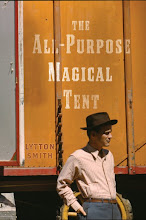
Lytton Smith grew up in Galleywood, England and now lives in New York City, where he studies Anglo-Saxon, travel, and poetics. A chapbook, Monster Theory, was selected by Kevin Young for a New York Chapbook Fellowship and was published this month by the Poetry Society of America. His book, The All-Purpose Magical Tent, won the Nighboat Poetry Prize, judged by Terrance Hayes, and is forthcoming from Nightboat Books in March 2009.

Scott Snyder's collection of stories, Voodoo Heart, was published in 2007 by the Dial Press. He teaches at Columbia University and Sarah Lawrence College and lives on Long Island with his wife, Jeanie, and their son, Jack Presley. He's currently at work on a novel to be published by Dial in 2009.

Todd Erickson, April’s featured artist, will present a talk on his current show, Light, which focuses on his Park Slope backyard. As an environmental artist, his previous installations have documented ecosystems fromFire Island to the Gowanus Canal. Born and raised on Long Island, he received a BFA from Parsons School of Design in 1999, a Certificate in Horticulture from the Brooklyn Botanic Gardens in 2007, and has participated in two artist residencies in Hokkaido, Japan. Todd is currently weaving his artistic practice, garden design sensibilities and knowledge in horticulture into a small business called L.O.G., Leaves of Green.

(Todd Erickson image via 440 Gallery's website.)
About 440 Gallery: Park Slope’s only artist-run gallery, a jewel box space offering an alternative venue for Brooklyn artists. 440 Gallery seeks to present surprising, unexpected art to the community through exhibitions, talks, readings and events centered around direct contact with the artist. Open Thursdays and Fridays from 4-7 pm, and Saturdays and Sundays from 12-6 pm, or by appointment.

Tuesday, April 15, 2008

Heartened (finally!)

Ron Silliman is judging the William Carlos Williams Award, awarded to the best book published by "a small press, non-profit, or university press" in the preceding calendar year (2007). He's been posting on it since Thursday, and I'm planning a considered post at some point soon.

Something Silliman had to say today, however, made me need to post. He'd expected to find many books that simply weren't competent among the 150 books he's been sent. In reality, he found 5. Setting aside those books that might prove amazing on re-reading but that he didn't "get" first time, and those that lack ambition (a good number), and those where he can't judge impartially (hurrah for making this decision), he writes that he has 70 left.

That there are at least seventy books worthy of such attention in any one year’s crop – not to mention those other volumes I held out on the basis of my relationship with their authors and those volumes that never got submitted – probably is the best assessment of the quality of writing that is taking place at this very moment. It’s really a stunning realization. At least it stunned me.
Ever since I got to the U.S. four and a bit years ago, I've had many people, usually poets, tell me how terrible contemporary poetry is. That simply isn't true: there's a wealth of great poetry out there, with huge ambition, and if we devoted our time to finding it and then telling other people about it, more people would be reading poetry. The tired reiteration that modern poetry isn't any good not only indicates a lack of engagement with what's out there (and yes, there is a distribution issue to address, but the blogs do such a great job talking up a range of books that it is no longer that hard to find something) but also does massive damage to the chances of occasional readers of poetry picking up a book.

I'm going to try to recommend at least one book of poetry a week on this blog, and to mention as many poets and poems as I can. In the meantime, one book Silliman must be considering and that I dearly loved is Paige Ackerson-Kiely's In No One's Land which I reviewed here. There's a lot of great books out there, many of which I didn't read, but among the many I read, this is a strong contender, methinks.